





From Arizona to the Showgrounds: A Country in Motion, One Call at a Time
From a Brisbane operator standing in a vast Arizona mine to a phone box in Newcastle, from the Murray River to the Nullarbor, and deep into the sheds of the Sydney Royal Easter Show — this week’s Australia All Over unfolded the way it always does.
Not as headlines.
But as voices.
Each call a window. Each story a fragment of a much bigger picture.
Simon Bailey — Brisbane to Arizona, One Pitch at a Time
Simon Bailey wasn’t calling from home — he was on a mine site in Arizona, managing dust on haul roads at what he reckons is the biggest open-cut mine he’s ever seen.
His Brisbane-based company, Barion, manufactures road maintenance products. But this job didn’t come through a formal process. He drove up to the site a year ago, saw the scale of the dust problem — “like Mars” — and pitched a solution.
A pilot program followed. Then a 12-month contract. Now discussions about rolling it out across five more mines.
The scale still catches him. Hundreds of trucks, each carrying up to 400 tonnes, running non-stop. A place where time barely matters — no holidays, no slowdown.
And yet, the personal detail cuts through.
He’ll miss his wedding anniversary. His family’s in Noosa. He’s in the desert.
That’s the trade-off behind the global story.
Trevor Richards — The Murray River, Seen Properly
Trevor had just completed a tinny rally from Mildura to Mannum — 92 boats moving down the Murray.
What stood out wasn’t the trip itself, but the contrast.
On the Victorian side: protected riverbanks, thick with red gums, grasses and reeds.
On the New South Wales side: livestock access, degraded banks, a visible difference you don’t need a report to understand.
“You can’t believe it hasn’t been addressed,” he said — especially with the Murray-Darling Basin Authority in place.
Then came the second observation, picked up from a farmer they camped with.
Almonds.
The numbers stuck: 12.5 million litres of water per hectare. About 13 litres per almond. Roughly 3,000 litres for a single almond latte.
Not outrage — just perspective.
The kind you only get when you’re sitting on the river, hearing it firsthand.
Stratis — A Phone Box and a View on Sport
Stratis was calling from a phone box near Newcastle Interchange — visiting family, walking the streets early, waiting for the day to unfold.
But what he really wanted to talk about was sport.
That night, he was heading to Maitland to watch women’s football — Newcastle Jets against Melbourne City.
His take was simple: women’s sport feels more genuine. More effort. More sincerity.
Macca pushed back — drifting into rugby league salaries and the idea of docking players’ pay if they lose.
“Make them try harder,” he joked.
Stratis didn’t mind the pushback. It was the kind of conversation that wanders — but lands somewhere real.
Quentin — Townsville, Finally Cooling Down
Quentin’s call from Townsville carried that unmistakable sense of relief that only comes after a long, oppressive wet season.
For the first time in months, the temperature had dipped below 20 degrees. After weeks of heat, humidity and flooding, it felt like the city could finally breathe again.
He was heading out for a run along The Strand — something locals don’t take for granted when the weather turns — taking in clear skies and a calm morning that had been missing for a while.
After his run, he was heading to drop off Easter eggs to people doing it tough. No fuss, no big framing — just something built into his Sunday.
Sean Haines — Bacon, Flood Recovery and the Meaning of the Show
Sean Haines from Yugara stood beside a prize-winning middle cut of bacon — first place at the Sydney Royal Easter Show.
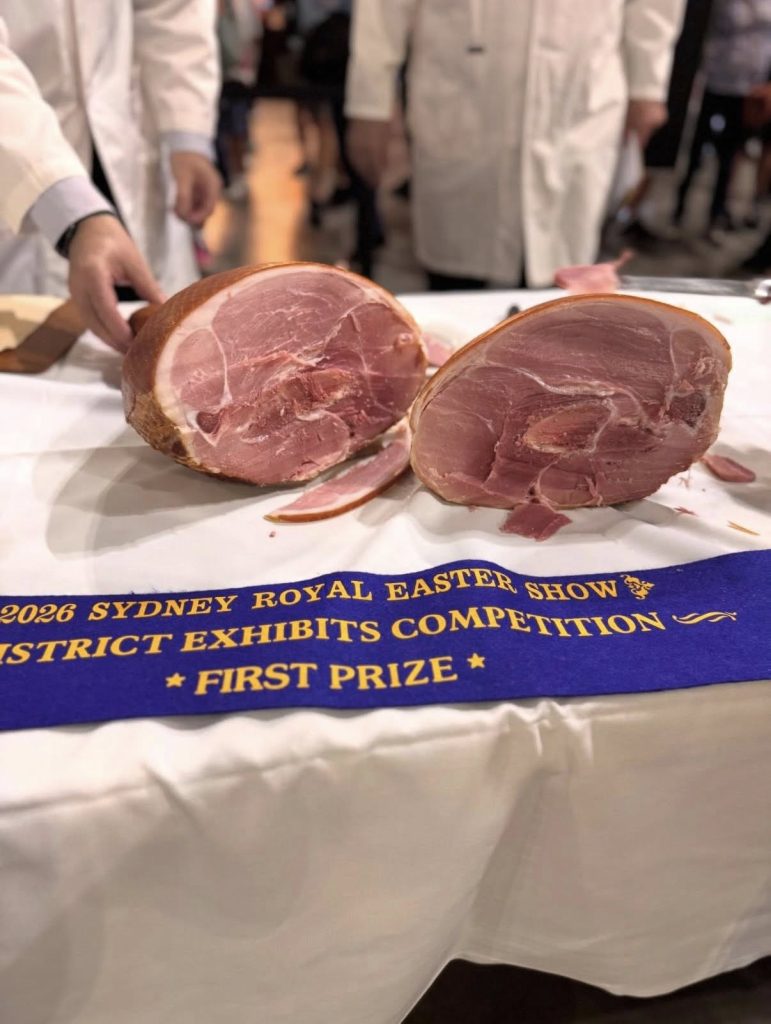
As a steward, he wasn’t there for himself but to help present the best produce from across the state — the kind of display that reminds people where their food actually comes from.
Macca lingered on that point. In a world that often feels chaotic, there’s something grounding about seeing real food, made properly, judged on quality.
But Sean’s perspective didn’t stop at the show bench.
Back home, the reality is still unfolding. More than three years after devastating floods, some families are still living in temporary pods, still waiting for permanent housing.
The community continues to push forward — restoring assets, supporting one another — but the timeline is longer than most would expect.
The show, in that sense, becomes more than an event. It’s a moment of recognition — of effort, resilience, and continuity.
Judy Hannon — Shows, Change and The Block
Judy Hannon had come up from regional Victoria with a purpose — to see how Sydney’s Royal Easter Show compared to Melbourne’s.
As a CWA Home Industries judge, she’s spent years around show culture, watching entries come and go, standards shift, and participation ebb and flow.
Melbourne, she said plainly, has changed. Entry numbers are down. The feel is different. Not what it once was.
In Sydney, she was walking the sheds, comparing layouts, observing how things are run — taking it in with the eye of someone who knows what she’s looking at.
Back home, things are quieter — “no nonsense” — though not without interest. Her area is hosting The Block, bringing a different kind of attention to what is usually a steady, low-key place.
Gus — Horses, the Nullarbor and the Cost of Distance
Gus was somewhere east of the Nullarbor, heading home after delivering 20 horses to cattle stations in the Kimberley.
It’s part of what he does — sourcing and transporting horses across the country.
This trip? Around 11,000 kilometres all up.
Fuel alone? Around $14,000 to $15,000.
He spoke about waiting out road closures, navigating cyclone-affected routes, and taking each leg as it comes.
But also about the moments — sunrises over the ocean, the view from the truck along the cliffs, the sense that every lap of Australia is different depending on the season.
Trevor Wright — Lake Eyre Coming Alive
From William Creek, Trevor Wright described a year he hadn’t seen in decades.
Rain has transformed the landscape. Vegetation is everywhere. The lake is filling.
Pelicans have arrived in huge numbers — tens of thousands — forming rookeries across the water.
And then there’s the colour.
In places like Madigan Gulf, the interaction of salt, temperature and water can turn vast stretches of the lake pink — kilometres wide.
If flows from the Diamantina and Cooper Creek systems arrive as expected, it could become a major fill.
It’s something you don’t just hear about out there.
You watch it unfold.
Mark Kierens — The Slow Loss of Glassmaking
At the show, Mark Kierens — a stained glass specialist — spoke about a quieter shift.
Australia no longer manufactures large-scale architectural glass.
Factories have closed. Skills are disappearing. Materials are harder to source.
Even stained glass is becoming rarer, with many overseas producers shifting to solar panel glass instead.
There are only a handful of tradespeople left doing the work.
It’s not dramatic.
But it’s final.
Cheryl — Spinning Wool, One Thread at a Time
Cheryl from Jervis Bay sat at a spinning wheel made from Huon pine — a 50-year-old piece still doing exactly what it was built to do.
She talked through the process — feeding raw merino wool into the wheel, spinning it one way, then reversing it to create a balanced yarn strong enough to use.
It’s a tactile, precise craft. One that relies on feel as much as technique.
She spoke about natural dyes — eucalyptus leaves, bark, plant-based colours — and how they bring beauty, but also challenges. Without strong mordants, they fade.
Still, the craft endures.
Younger people are coming through, just in different ways — night groups, weekend sessions, community guilds like the one in Eastwood where courses run year-round.
For Cheryl, it started with curiosity — seeing a spinning wheel in a shop and deciding to try.
She never really stopped.
Dan Harrison — Trying to Cool the Reef
Dan Harrison, an oceanographer from the National Marine Science Centre, is working on ways to reduce coral bleaching on the Great Barrier Reef.
One idea: marine cloud brightening.
Using cloud cover to reflect sunlight and cool ocean temperatures.
He spoke about the complexity — cyclones that can damage reefs, or sometimes protect them by cooling the water. Floods that can harm or help depending on timing and intensity.
Nothing about it is simple.
But the work continues.
Judy (Bundaberg) — The Truth Behind “Australian Made”
Judy, a soybean farmer from Bundaberg, raised a concern about how “Australian Made” is being used.
Soy milk sold under major supermarket brands can carry the label — even when the soybeans are imported — because the product is mostly Australian water.
Locally grown soybeans are being overlooked.
Meanwhile, farmers like her continue growing soy in rotation with sugarcane, using its natural ability to fix nitrogen and improve soil health.
It’s a practical system.
But one that isn’t always reflected in what consumers see.
Dave Conroy — The Orange Cake
Dave Conroy, a 65-year-old plumber, entered an orange cake into the show.
What started as a whim became a process.
Eighteen cakes. Testing ingredients. Refining consistency.
The recipe came from his grandmother.
Standing there on judging day, he was nervous — but clear about what it meant.
“Life is like a cake… it’s the ingredients, the blending, the time in the oven.”
Gary — Racing, Tradition and a Changing Crowd
Gary, a bookmaker at Randwick, had seen the industry shift over decades.
He spoke about the Doncaster, about betting movements, about horses running above expectations.
But also about something else — crowds.
They’re not what they used to be. Traditions like big Monday race days have faded.
Bookmaking has become tougher. Fewer people are entering the trade.
“If it was any good,” he said, “they’d be lined up.”
Louise — Karratha, Cyclones and the Long Drive South
Louise had been waiting for roads to reopen after Tropical Cyclone Narelle.
Finally, they had.
She was heading south from Karratha to Dongara to spend Easter with family.
There’s always uncertainty — conditions, weather, delays — but once the road opens, you go.
Heidi and Steve — Camping, Trucks and the Cost of Fuel
Heidi was camping with a group at Bawley Point — 12 people this weekend, more during their larger annual trips.
A mix of caravans, a bit of rain, a bit of sun — “glamping,” as she called it.
Then Steve came on.
A livestock truck operator, covering routes across New South Wales, Victoria and Queensland.
Fuel prices have surged — from around $1.75 to over $3 in a matter of weeks.
For now, they pass the cost on.
Beyond that, like most, he’s unsure.
Jeff — Brass Bands, Tradition and the Next Generation
Jeff spoke about his friend Vaughan Price — a lifelong brass band player with the Warringah Brass Band, competing in Brisbane at the National Championships.
Vaughan’s story is steeped in tradition — growing up in a family where playing a brass instrument wasn’t optional, it was expected. Cornet, trumpet, rehearsals, discipline — a lifetime shaped by band culture.
But what struck Jeff most wasn’t just that history.
It was the present.
Half the band, he said, were young — many under 25 — choosing to commit their time to something that demands patience, repetition and effort.
“They wouldn’t be there unless they felt welcome… and unless they enjoyed it.”
He had been at their final rehearsal before the trip — the energy, the camaraderie, the sense of purpose.
Not just about competing.
About being together.
About keeping something going.
One Conversation at a Time
Across the morning, the calls stretched from Arizona to the Murray, from the Nullarbor to Lake Eyre, from Bundaberg farms to Sydney showgrounds.
Some were long. Some were brief.
But each added something.
Not a single headline.
But a country — moving, working, thinking — revealed piece by piece.
One conversation at a time.
Listen to the podcast episode here.
Disclaimer: ‘Australia All Over’ is a program produced and broadcast by the ABC Local Radio Network and hosted by Ian McNamara. Brisbane Suburbs Online News has no affiliation with Ian McNamara, the ABC, or the ‘Australia All Over’ program. This weekly review is an independent summary based on publicly available episodes. All original content and recordings remain the property of the ABC. Our summaries are written in our own words and are intended for commentary and review purposes only. Readers can listen to the full episodes via the official ABC platforms.