



By Jack Mercer – Rabbit Hole Fisherman
From John Steinbeck and Woody Guthrie to Bruce Springsteen and Tom Morello, the story of a song that travelled through generations before two very different guitarists brought it roaring to life.
In This Story
- A character who refused to disappear
- The film Bruce Springsteen couldn’t identify
- Tom Morello was listening
- The first transformation
- The night two musical worlds collided
- The guitar solo that changed everything
- The Australian connection
- Two guitarists from different worlds
- A song with a history older than rock music
- The performance worth watching
When Steven Spielberg appeared on BBC Radio 4’s Desert Island Discs in December 2022, he chose Bruce Springsteen’s The Ghost of Tom Joad as one of the eight recordings he would take with him.
He also chose The Grapes of Wrath by John Steinbeck.
Those choices were linked by more than a passing interest in American history. Steinbeck created Tom Joad in 1939. Springsteen revived him in song more than half a century later. And Tom Morello, the guitarist from Rage Against the Machine, later helped turn Springsteen’s quiet acoustic composition into a dramatic rock performance.
The song Springsteen released in 1995 bears little resemblance to the version he and Morello would eventually perform together. One is restrained and intimate. The other builds toward an extended electric-guitar solo that transforms the material into something far more expansive.
Yet both are unmistakably the same song.
And the story of how they came together begins long before either musician was born.
A character who refused to disappear
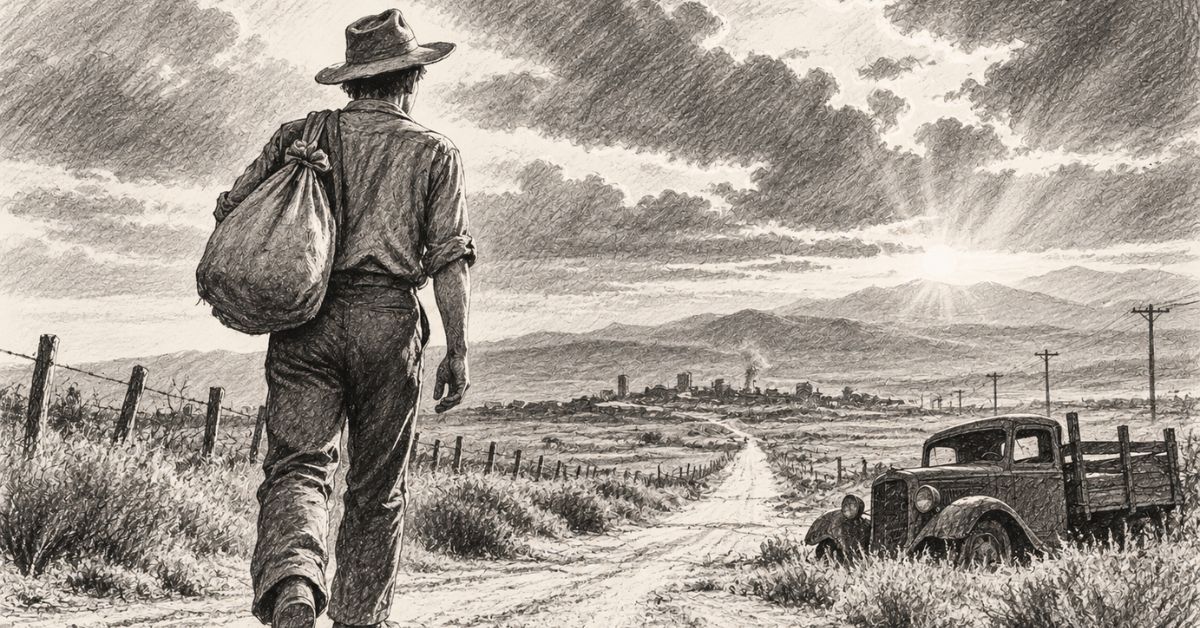
In 1939, John Steinbeck published The Grapes of Wrath, his novel about the Joad family, who leave Oklahoma for California during the Great Depression.
The family hopes to find work and a better life. Instead, they encounter exploitation, poverty and hostility.
Tom Joad, the novel’s central character, gradually becomes more than a young man trying to survive difficult circumstances. His experiences lead him toward a broader understanding of injustice and the struggles of people around him.
The following year, John Ford brought the novel to the screen, with Henry Fonda playing Tom. The film became one of the defining American dramas of its era.
The character also found his way into music.
In 1940, Woody Guthrie recorded “Tom Joad,” a lengthy folk ballad that retold the story from Steinbeck’s novel and Ford’s film. Guthrie was already developing the musical approach that would make him enormously influential: direct language, memorable melodies and stories about ordinary people whose lives rarely appeared in popular entertainment.
Decades later, that approach would profoundly influence Bruce Springsteen.
But Springsteen’s connection to Tom Joad had another beginning.
And it involved a television set.
The film Bruce Springsteen couldn’t identify
Springsteen’s longtime manager Jon Landau once recalled an evening when the singer told him about an extraordinary film he had stumbled across on late-night television.
Springsteen had not seen the beginning. He did not know its title. But the story had stayed with him.
As Springsteen described the film, Landau recognized it: John Ford’s The Grapes of Wrath.
The encounter deepened Springsteen’s interest in Steinbeck and the world he had depicted.
By then, Springsteen had already built a career writing about people struggling to make something of their lives. Songs such as “The River,” “Atlantic City” and “Johnny 99” explored economic hardship, desperation and the consequences of limited opportunity. His 1982 album Nebraska had shown how powerful those stories could be without the full E Street Band sound.
Recorded largely as home demos, Nebraska was stark, unsettling and deliberately spare.
Thirteen years later, Springsteen returned to that territory.
His 1995 album The Ghost of Tom Joad was largely acoustic. The title track brought Steinbeck’s character into a more contemporary American landscape, drawing connections between the hardships of the Depression and the experiences of people living on society’s margins.
This was not a cover of Guthrie’s 1940 song. Springsteen wrote a new composition, using the same literary character and drawing on a folk tradition Guthrie had helped define.
The result was a long way from “Born to Run” or “Dancing in the Dark.”
And it caught the attention of a guitarist who, at first glance, seemed like an unlikely admirer.
Tom Morello was listening
By the mid-1990s, Tom Morello was one of the most distinctive guitarists in rock.
With Rage Against the Machine, he had developed a sound that could be abrasive, explosive and almost impossible to identify as conventional guitar playing. Morello treated the instrument as something more than a source of chords and solos. He used effects, unconventional picking techniques and manipulation of the guitar’s controls to create sounds resembling turntables, sirens and electronic machinery.
Rage Against the Machine’s music combined heavy riffs with politically charged lyrics and an aggressive live performance style.
Springsteen’s acoustic The Ghost of Tom Joad seemed to belong to another world.
But Morello was listening closely. He admired Springsteen’s quieter recordings, particularly Nebraska and The Ghost of Tom Joad. In interviews during the 1990s, Morello discussed Springsteen’s connection to Woody Guthrie and the American folk tradition. He recognized something in Springsteen’s songwriting that connected with his own musical interests.
The two guitarists approached music differently, but both were interested in telling stories about people confronting powerful institutions and difficult circumstances.
Morello would eventually explore that tradition himself through his acoustic project, the Nightwatchman.
Before that, he had another idea.
What if Rage Against the Machine recorded “The Ghost of Tom Joad”?
The first transformation
In 1997, Rage Against the Machine released their interpretation of Springsteen’s song.
It was a dramatic departure from the original. Where Springsteen’s recording was quiet and reflective, Rage Against the Machine introduced heavy electric guitar, driving rhythms and Zack de la Rocha’s forceful vocals.
The underlying composition remained recognizable, but the atmosphere changed completely.
Morello later explained that he had suggested the song while the band was preparing material around the time of its tour with U2. The group developed its own arrangement, turning Springsteen’s acoustic narrative into a hard-edged rock recording.
The cover was released in November 1997 and later appeared again on Rage Against the Machine’s 2000 album Renegades, according to the band’s official history and contemporary coverage in Billboard and the Rage Against the Machine official biography.
This matters because the transformation from folk to heavy rock happened years before Morello ever performed the song with Springsteen.
For the moment, however, the two men were pursuing separate careers. Springsteen continued recording and touring. Rage Against the Machine became one of the defining alternative rock bands of its generation. Morello later formed Audioslave with Chris Cornell and former Rage Against the Machine bandmates.
Then, in 2008, the two worlds met.
The night two musical worlds collided
In April 2008, Bruce Springsteen and the E Street Band were performing at the Honda Center in Anaheim, California.
Morello had encountered Springsteen at a recording studio shortly beforehand. Springsteen suggested that they perform “The Ghost of Tom Joad” together.
For Morello, the invitation was extraordinary. He had been playing Springsteen’s song for years. Now he was being asked to perform it with the man who wrote it.
There was a complication, though. The arrangement Springsteen intended to use was in a different key from the version Morello knew. Morello would also be singing as well as playing guitar.
He later recalled being unusually nervous about the prospect of performing alongside one of his musical heroes.
On 7 April 2008, Morello joined Springsteen and the E Street Band onstage. They performed “The Ghost of Tom Joad.” Morello returned for another performance the following night.
What emerged was neither Springsteen’s original acoustic recording nor Rage Against the Machine’s heavy interpretation. It was something else.
Springsteen’s vocal delivery anchored the song. Morello brought the heavier arrangement and his distinct electric-guitar approach. The musicians exchanged vocals, and Morello’s guitar became an increasingly prominent part of the performance.
The collaboration had begun.
And it would not end in Anaheim.
The guitar solo that changed everything
There are guitar solos designed to demonstrate speed. Others are built around melody. Some become famous because a guitarist finds a handful of notes that seem impossible to improve upon.
Tom Morello’s solo on “The Ghost of Tom Joad” belongs to another category.
It is a dense, inventive passage of sounds, textures and techniques that pushes the song well beyond conventional rock guitar. Morello uses the instrument’s controls and electronic effects to produce abrupt changes in pitch, sustained notes, distorted textures and sounds that sometimes resemble machinery more than strings.
But the technical ingenuity is only part of its appeal.
In a 2014 interview with MusicRadar, Morello explained that he wanted the solo to express the emotions and struggles represented in the song. His intention was not simply to produce an impressive display of guitar technique. He wanted the instrument to communicate something that the lyrics had already established.
That helps explain why the solo works so effectively within the composition.
Springsteen’s original recording is restrained. Its power comes partly from what it withholds.
Morello’s guitar takes the opposite approach. It releases the tension.
The contrast is large, and when the two musicians perform together, the song moves from one emotional extreme to another. The audience hears Springsteen’s narrative before Morello’s guitar takes over.
The result is not merely a louder version of the original.
It is a different interpretation of the same material.
And it was about to acquire an Australian chapter.
The Australian connection
In 2013, Springsteen returned to Australia with the E Street Band.
Longtime guitarist Steven Van Zandt was unavailable for part of the tour because of his commitments to the television series Lilyhammer. Morello stepped in.
It was a significant opportunity for both musicians. Morello was no longer simply a guest guitarist appearing for one song. He was performing with one of rock’s most established touring bands, playing a substantial part of Springsteen’s catalogue.
The collaboration proved successful. Morello later recalled recording material with Springsteen in Sydney during this period. Those sessions contributed to Springsteen’s 2014 album High Hopes.
Morello played on eight tracks on the album, including a new recording of “The Ghost of Tom Joad.”
The song had now completed another transformation.
It began as a quiet Springsteen composition in 1995. Rage Against the Machine reinvented it in 1997. Springsteen and Morello combined their approaches onstage in 2008. And in 2014, the collaboration became an official Springsteen studio recording.
For Australian audiences who saw the 2013 tour, the partnership was more than a musical curiosity. They were witnessing a relationship that would become part of Springsteen’s recorded catalogue.
Two guitarists from different worlds
The collaboration becomes more interesting when you consider the musicians themselves.
Springsteen grew up in New Jersey, absorbing rock and roll, soul and the American folk tradition. His reputation was built on songwriting that combined vivid characters with stories about work, relationships, ambition and disappointment.
Morello grew up in Illinois and studied political science at Harvard before establishing himself as one of rock’s most unconventional guitarists. His playing with Rage Against the Machine challenged many assumptions about what an electric guitar was supposed to sound like.
Springsteen’s guitar work generally serves the song. Morello often makes the guitar sound like an entirely different instrument.
Yet both understood the emotional possibilities of the material.
There was also an interesting reversal in their relationship. Morello had taken Springsteen’s folk song into the world of heavy rock. But Springsteen’s acoustic music had also helped inspire Morello’s own work as the Nightwatchman. The influence was not flowing in just one direction.
Two musicians who approached similar subjects through radically different styles eventually found themselves performing together.
And the song that connected them was one neither had originally imagined as a duet.
A song with a history older than rock music
Return for a moment to Tom Joad.
Steinbeck created him in 1939. John Ford brought him to cinema audiences in 1940. Woody Guthrie turned his story into a folk ballad that same year. Springsteen revived the character in 1995, using him to explore contemporary experiences of poverty and displacement. Morello and Rage Against the Machine transformed Springsteen’s song into heavy rock in 1997. Then Morello and Springsteen began performing it together in 2008, eventually recording their collaboration for High Hopes in 2014.
Each stage changed the way the material was presented.
The underlying themes endured.
That is why Spielberg’s Desert Island Discs selections are such a satisfying connection. When he chose “The Ghost of Tom Joad” as one of his eight records, he was selecting a song that had travelled through literature, cinema, folk music and rock. When he chose The Grapes of Wrath as his book, he returned to the work that had started the journey.
The two choices were separated by decades of American cultural history.
Yet they belonged to the same story.
The performance worth watching
There are songs whose original recordings remain definitive.
And there are songs that acquire new lives when other musicians reinterpret them.
“The Ghost of Tom Joad” has done both.
Springsteen’s 1995 recording remains a powerful example of restrained storytelling. Rage Against the Machine showed how dramatically the song could change without losing its identity. But the Springsteen–Morello performances offer something especially unusual.
You can hear the musical histories of both men colliding.
Springsteen brings the narrative. Morello brings the sound world that has defined much of his career. Somewhere in the middle, a song written in the acoustic folk tradition becomes a large-scale rock performance.
There is something especially compelling about watching Morello take that solo. He is not a young guitarist trying to impress an established star. He is a musician who admired the original song, recorded his own version and eventually found himself standing alongside its composer.
The solo is memorable.
The story behind it makes it more so.
A fictional character from a 1939 novel. A folk singer in 1940. A young musician watching an unidentified film on late-night television. Another guitarist discovering an acoustic album decades later. A chance to perform together in California. And a musical partnership that eventually reached Australia.
All connected by one song.
If you have only heard Springsteen’s original recording, listen to the version with Tom Morello. And if you have only heard the rock version, go back to the quiet recording from 1995.
The difference between them is striking.
The journey connecting them is the real story.