



By Jack Mercer – Rabbit Hole Fisherman
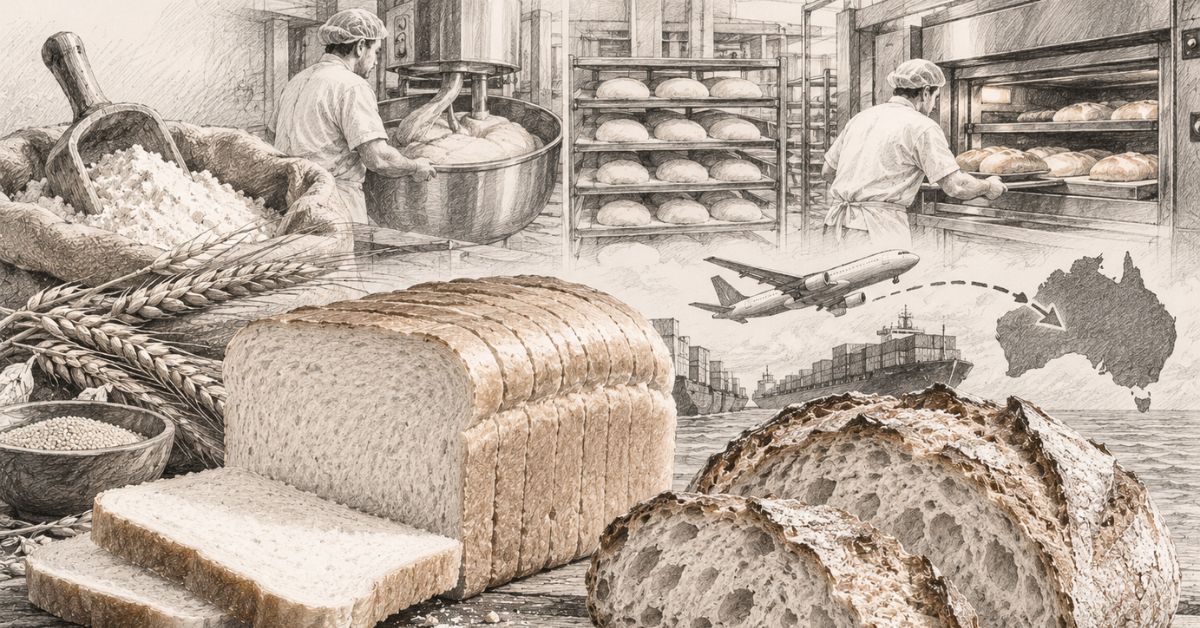
Why supermarket bread stays soft is a question many shoppers never ask, but the answer involves starch molecules, enzymes, preservatives and packaging. Buy a loaf of supermarket bread on Monday and it may still make a respectable sandwich on Friday. A crusty loaf from a traditional bakery can be considerably less cooperative. There is also the documented story of bread partially baked overseas, frozen and shipped to Australian supermarkets for finishing in an oven.
In This Story
- The strange science of stale bread
- What makes sliced bread stay soft?
- The numbers on the packet
- Stale bread and mouldy bread are different problems
- Why bakery bread can behave differently
- When ‘freshly baked’ bread had already been partly baked overseas
- Does the manufacturing method affect nutrition?
- The fridge is not necessarily your bread’s friend
- What to look for when buying bread
- A loaf designed for the way we live
Bread has an unfortunate habit of being at its best just when you’re least likely to appreciate it.
A warm loaf from a bakery, with its crisp crust and soft centre, can be magnificent on the afternoon it was baked. By the following morning, the crust has lost some of its appeal. Another day or two and the bread may be better suited to toast, particularly if it has been left exposed to the air.
Meanwhile, the sliced loaf in its plastic bag is getting on with the business of making school lunches. Several days after purchase, the slices may still be soft enough to fold around a filling without breaking.
Both products began with flour and water. Both were baked. Yet they behave quite differently once they leave the oven.
For a start, bread can become stale without losing much water at all.
The strange science of stale bread
Most people assume bread goes stale because it dries out. Moisture loss certainly contributes to changes in bread, particularly when a loaf is left unwrapped. But it doesn’t adequately explain what happens to the soft interior of bread as it ages.
Much of the explanation lies in starch.
Wheat flour contains two principal forms of starch molecule, amylose and amylopectin. During baking, starch granules absorb water and undergo changes that help create the soft structure of the finished loaf. As the bread cools and ages, some of those changes begin to reverse.
Starch molecules gradually reorganise into more ordered structures, a process known as retrogradation. Amylopectin retrogradation is particularly important in the firming of bread during storage. Water also moves within the bread’s structure, affecting the relationship between starch, proteins and other components.
The result is familiar to anyone who has tried to make a sandwich with yesterday’s crusty loaf. The crumb becomes firmer, even though the bread hasn’t necessarily lost enough moisture to explain the change.
Researchers have been studying this process for decades. A 2003 scientific review by J.A. Gray and J.N. BeMiller examined the molecular basis of bread staling, while a further review published in 2014 explored the roles of starch retrogradation and water redistribution.
This helps explain why stale bread often improves when toasted. Heating can temporarily reverse some of the changes associated with starch retrogradation, making the bread seem softer and more appealing. The improvement doesn’t last indefinitely. Leave the toast sitting around and it soon develops problems of its own.
Bread manufacturers have spent considerable time finding ways to slow the original firming process.
What makes sliced bread stay soft?
The standard supermarket sandwich loaf is designed for a particular job. It needs to be soft, easy to slice, consistent from one purchase to the next and capable of remaining acceptable throughout its stated shelf life.
Those requirements influence everything from the flour and recipe to the mixing, baking, cooling and packaging.
One important difference can be the use of emulsifiers. Emulsifiers help ingredients interact in ways that influence dough handling, crumb structure and softness. Some can also affect the changes in starch that occur as bread ages.
Then there are enzymes. Enzymes are proteins that accelerate particular chemical reactions. Bakers have long relied on enzymes naturally present in flour, and modern commercial baking can also use added enzymes to achieve specific results.
Certain amylase enzymes act on starch during breadmaking. Depending on the enzyme and how it is used, this can influence loaf volume, crumb characteristics and the rate at which bread firms during storage.
The science is more complicated than simply adding something that keeps bread moist. A formulation has to work through mixing, fermentation, baking and storage. Ingredients that improve one characteristic may affect another. Manufacturers therefore select combinations suited to the bread they want to produce.
A soft sandwich loaf is a different product from a crusty baguette, and the recipe reflects that.
The numbers on the packet
Food additive numbers can make a bread label look more complicated than it really is. Australian food-labelling rules generally require additives to be identified by their function and either their name or number.
The number itself doesn’t tell you whether an ingredient is dangerous. It is part of a recognised identification system. Food Standards Australia New Zealand regulates which additives may be used in particular foods and under what conditions.
One preservative associated with commercial breadmaking is calcium propionate, identified as additive 282. Its principal purpose is to inhibit the growth of certain moulds and other microorganisms.
That is a different job from the one performed by ingredients intended to keep bread soft. The distinction is essential to understanding why some loaves last longer than others.
Stale bread and mouldy bread are different problems
A loaf can become stale without showing any mould. Equally, bread can remain relatively soft while conditions allow mould to develop.
Staling is largely concerned with physical and chemical changes in the bread. Mould growth is a microbiological problem.
Bread can support a range of moulds when environmental conditions permit their growth. Mould spores are common in the environment. They can reach bread after baking through contact with air, equipment, packaging materials or other surfaces.
Baking destroys many microorganisms present in the dough, but the bread is subsequently cooled, sliced, handled and packaged. Each stage has to be managed hygienically.
Preservatives such as calcium propionate can help inhibit mould growth, although their effectiveness depends on the formulation and storage conditions. Not every loaf contains the same preservatives, and some breads are manufactured without added chemical preservatives.
Packaging also matters. A sealed plastic bag helps limit moisture loss and provides a barrier against contamination after packing. It doesn’t make the bread sterile, and it doesn’t guarantee that mould will never develop.
Temperature, humidity, handling and the product’s composition all affect how long it remains acceptable. The softest loaf isn’t necessarily the one that will resist mould for the longest period.
Why bakery bread can behave differently
A traditional crusty loaf is often designed around characteristics that don’t suit a packaged sandwich loaf. A baker may want a pronounced crust, an open crumb structure and flavours developed through fermentation.
Those characteristics influence the finished bread’s texture and how it changes during storage. A crisp crust depends partly on differences in moisture between the outside and inside of the loaf. Over time, moisture moves through the bread and the crust loses some of its crispness.
A plastic bag may help retain moisture and keep the crumb soft, but it can also soften the crust. Leave the loaf unwrapped and the crust may fare better initially, while the interior loses moisture more readily. Neither storage method produces the ideal result for every type of bread.
Fermentation also influences flavour. Yeast produces carbon dioxide, which helps dough rise, along with compounds that contribute to the aroma and flavour of bread. Longer fermentation and sourdough processes can produce different flavour profiles and changes in dough properties, depending on the ingredients and conditions used.
Commercial breadmaking isn’t necessarily devoid of fermentation, nor is every independent bakery using a long fermentation process. The methods vary considerably. But a bread designed to remain soft in a plastic bag for several days will generally have different priorities from a loaf intended to be eaten with dinner shortly after baking.
When ‘freshly baked’ bread had already been partly baked overseas
More than a decade ago, an unusual Australian court case revealed how complicated the journey from bakery to bread shelf could become.
In 2013, the Australian Competition and Consumer Commission took legal action over the marketing of certain bread products sold through Coles supermarkets. Some products had been partially baked and frozen before arriving at the supermarkets, then finished in in-store ovens. Contemporary reporting identified Ireland as the origin of certain products.
This process is known as par-baking. A manufacturer completes part of the baking process, cools and freezes the bread, and transports it for finishing elsewhere. Centralised production can offer consistency and make it possible to finish bread close to the time of sale.
The court case concerned the descriptions used to market the products, rather than a finding that par-baking was unsafe. In June 2014, the Federal Court found that particular claims, including descriptions suggesting bread was freshly baked in-store, were misleading in the circumstances. In April 2015, penalties totalling $2.5 million were imposed.
This is a historical episode, not evidence about how any particular supermarket operates today. Nor do the verified findings establish that bread was flown specifically to Brisbane or that tax considerations drove the arrangement.
It does, however, illustrate an important distinction. A loaf can emerge from a supermarket oven that morning without having been mixed, shaped or initially baked on the premises. For a shopper who wants bread made from scratch at the store, that difference matters.
Does the manufacturing method affect nutrition?
It’s easy to assume that bread containing fewer ingredients must be healthier. Sometimes a simpler formulation may suit a consumer’s preferences, but ingredient count alone is a poor measure of nutritional quality.
A white loaf made with flour, water, yeast and salt can still be relatively low in dietary fibre. A commercially manufactured wholegrain loaf may contain additional ingredients while providing considerably more fibre.
The amount and type of grain matter. So do sodium levels, serving sizes and the bread’s overall nutritional composition. The Australian Dietary Guidelines recommend choosing mostly wholegrain or high-fibre grain foods.
That advice provides a more useful starting point than deciding whether a loaf is healthy simply because it came from an independent bakery or a supermarket. The presence of a permitted food additive also doesn’t automatically make a bread nutritionally inferior.
Consumers may prefer products without certain additives, but that preference should be distinguished from evidence that a permitted ingredient is harmful at the levels used.
A practical comparison between two loaves should begin with their nutrition information panels: dietary fibre per 100 grams, sodium, the proportion of wholegrain ingredients where stated, and ingredients relevant to individual dietary needs.
The fridge is not necessarily your bread’s friend
Putting bread in the refrigerator can make it firm more quickly. The cool temperatures of ordinary refrigeration can accelerate some of the starch changes associated with staling.
That doesn’t mean refrigeration is always the wrong choice. In hot or humid conditions, it may help manage mould growth, depending on the bread and how it is stored. But there is a trade-off between slowing microbial spoilage and maintaining the texture of the crumb.
For bread that won’t be eaten soon, freezing is often useful. Freezing greatly slows deterioration, and individual slices can be removed as needed. A loaf can be divided into portions before freezing, reducing the need to thaw more than will be eaten. The manufacturer’s storage instructions remain the appropriate starting point.
What to look for when buying bread
Most shoppers don’t need to become food scientists to make a sensible choice. The label provides useful information about ingredients, additives, nutrition and storage. The type of bread tells you something about the texture and eating experience it was designed to deliver.
A packaged sandwich loaf may be ideal for lunches, while a crusty bakery loaf might be preferable with soup or dinner. Neither is inherently the better product for every purpose.
When softness matters, ingredients and packaging can help explain why some loaves retain it longer. For readers avoiding particular preservatives, check the ingredient declaration. On nutritional quality, fibre, wholegrain content and sodium deserve more attention than the number of unfamiliar words on the packet.
If a loaf develops visible mould, discard it rather than simply cutting away the affected portion. Mould can extend beyond the visible growth in porous foods such as bread.
A loaf designed for the way we live
The modern sliced loaf is a product of changing household habits as much as developments in food science. Families want bread that can be bought during a weekly shop, stored conveniently and used over several days.
Commercial bakers have developed methods that help meet those expectations, drawing on a detailed understanding of dough, starch, fermentation, microorganisms and packaging.
Traditional bakery bread often offers something different, particularly when the baker concentrates on crust, fermentation and flavour rather than prolonged softness.
The differences become easier to understand once you recognise that bread begins changing as soon as it leaves the oven. Some of those changes are part of what makes a freshly baked loaf enjoyable. Others eventually make it stale.
The supermarket loaf hasn’t escaped the chemistry of bread. Its recipe, processing and packaging have been designed to manage that chemistry for longer.
And the old Irish bread case is a reminder that a loaf’s history doesn’t necessarily begin where a customer sees it coming out of the oven.